


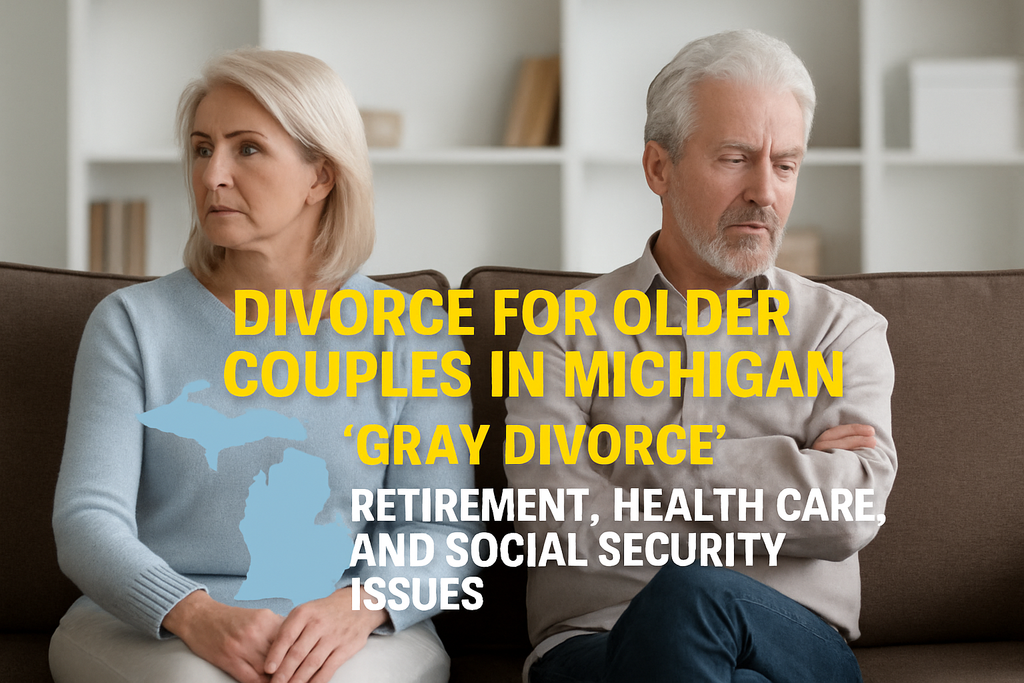
Divorce is challenging at any age, but for older couples in Michigan, the issues can be more complex. Often called a “gray divorce” by family law attorneys, spouses divorcing in their 50s, 60s, or even later face unique financial and legal questions about retirement accounts, pensions, health care coverage, and Social Security benefits. In Lansing area counties like Ingham, Eaton, Clinton or Livingston, where many couples have spent decades building families, careers, and retirement savings, the outcome of a divorce could potentially destroy retirement plans.
Michigan Law on Divorce and Property Division
Michigan is called an equitable distribution state, meaning marital property is divided fairly, though not always equally. Michigan courts may divide real and personal property, pensions, retirement accounts, and other assets acquired during the marriage. For older couples, their largest assets are often pension and retirement accounts, and their real estate.
Courts look at the “Sparks factors”, which include the length of the marriage, contributions to the marital estate, age and health of the parties, earning abilities, and needs, when dividing assets. These factors carry significant weight in gray divorces, especially when one spouse has limited earning potential. Family court judges are not limited to only the Sparks factors when they consider dividing the marital estate. For instance, the needs of each spouse is important, which might be affected by the health of the wife or the husband.
Retirement Concerns in Gray Divorce
For couples close to retirement in Lansing, Williamston, Brighton, DeWitt or Charlotte, divorce can derail years of financial planning. One or both spouses may be forced to delay retirement or even return to the workforce due to divided savings or new spousal support (alimony) obligations. You should bring this concern up with your divorce attorney to discuss options you may have to protect yourself financially. Some items you may want to discuss include:
- Retirement accounts (401(k), 403(b), 457, ESOP, IRAs, pensions) – Michigan law treats these as marital assets when earned during the marriage. Meaning they are subject to division through a Qualified Domestic Relations Order (QDRO) or another court order. Without a properly drafted court order, or a QDRO, tax penalties and financial losses could burden the recipient. The division of retirement accounts is a complex mixture of federal law and state law and should be handled by experienced attorneys with training in this area of the law.
- Marital homes – Often, one spouse may want to keep the home, while the other may prefer retirement savings or cash instead. Sometimes, neither spouse will be able to afford to keep the home and it will get sold.
- Business interests or investments – Long-standing businesses and investment accounts will complicate division. When businesses are a part of the marital estate, family law attorneys often bring in trained experts to appraise the business. When there are investment accounts to divide, divorce lawyers might rely on tax professionals to assist with determining the tax consequences of transferring or liquidating investments.
- Spousal support (alimony) – The court might award spousal support based on need, ability to pay, and the length of the marriage, among many other factors. In a long-term marriage, lifetime or long-duration alimony may be considered.
Health Care Coverage After Divorce
Health care can be a big concern for older divorcing spouses.
- If one spouse relied on the other’s employer health insurance, divorce usually terminates that coverage. Michigan divorce law requires support orders to address health care coverage.
- Spouses over 65 may qualify for Medicare, but those under 65 may need COBRA continuation coverage or to purchase private insurance, both of which can be expensive. It’s important to discuss this with your family law attorney so that it can be factored into the property settlement and spousal support discussions.
Social Security Benefits in Michigan Gray Divorce
Unlike pensions and retirement accounts, Social Security is a federal benefit and not divisible as “marital property” under Michigan law. Because Michigan courts cannot divide Social Security directly, attorneys often consider it when negotiating spousal support or offsetting the division of other assets. Therefore, it is vital that you discuss this with your attorney. One thing to consider is that a divorced spouse may collect spousal benefits on an ex-spouse’s record if the marriage lasted at least 10 years, the spouse is unmarried, and they are age 62 or older. When one spouse collects Social Security benefits based on the other spouse’s earnings, that will not decrease the other spouse’s Social Security benefits.
FAQs About Gray Divorce in Michigan
1. Can my spouse take half my pension in a Michigan divorce?
Probably, if the pension was earned during the marriage, it is marital property and subject to division. You should discuss with your divorce attorney what options are available to you to protect your retirement.
2. Will I lose my health insurance after divorce?
If the health insurance is carried by your spouse’s employer, generally, yes. You may qualify for COBRA, or you may have to purchase private insurance. You may also be eligible for Medicare or Medicaid. You might also qualify for subsidized medical insurance coverage (Obamacare) on the health care exchange. Courts may require your ex-spouse to contribute to your health care costs.
3. Does divorce negatively affect my Social Security benefits?
No. You may qualify for spousal benefits on your ex-spouse’s record if your marriage lasted 10+ years and you have not remarried.
4. Can I still retire when I plan to if I get divorced?
It depends on how your retirement assets are divided. Many couples need to adjust retirement timelines as you are taking assets originally planned to support one household and dividing it between two households. Your attorney or a financial planner can give you a more realistic idea of how your assets are likely to be divided.
Why You Need an Attorney in a Michigan Gray Divorce
In places like St. Johns, Grand Ledge, Mason, Howell, Jackson and elsewhere in the Lansing area, the financial stakes in a gray divorce are high. Missteps in dividing pensions, retirement accounts, or failing to account for health care and Social Security can have lifelong consequences. If you are considering a divorce at a later stage in life, it is crucial that you speak with an attorney with decades of experience practicing family law as soon as possible to protect your financial future. A skilled divorce attorney can:
- Ensure QDROs are drafted correctly by trained legal professionals in order to protect retirement savings.
- Ensure spousal support reflects medical needs and reduced earning capacity.
- Advocate for fair division of long-term assets.
- Plan around Social Security eligibility and retirement income streams.
Contact Our Office Today!
If you are in Ingham, Jackson, Eaton, Lansing or Clinton County and are considering divorce at a later stage in life, you deserve a tough, experienced family law attorney who fights for your rights and assets to be protected. At The Kronzek Firm, we have decades of experience in handling divorces for people in all stages of life. We understand how challenging property division can be, especially when you have worked your entire life for what you have and want to protect it. We are here to help ease some of that burden for you. Contact us today and let us help you protect what is yours so you can live your golden years with peace and security.
📞 Our highly respected attorneys have fought for thousands of Michigan clients for more than 30 years. You can reach our Lansing office 24/7 by calling (517) 886-1000 or by email at contactus@kronzek.law. Our team is also available 24/7 for emergency consultations.
[Disclaimer: This content is for informational purposes only and does not constitute legal advice. Consult an attorney for personalized guidance.]